
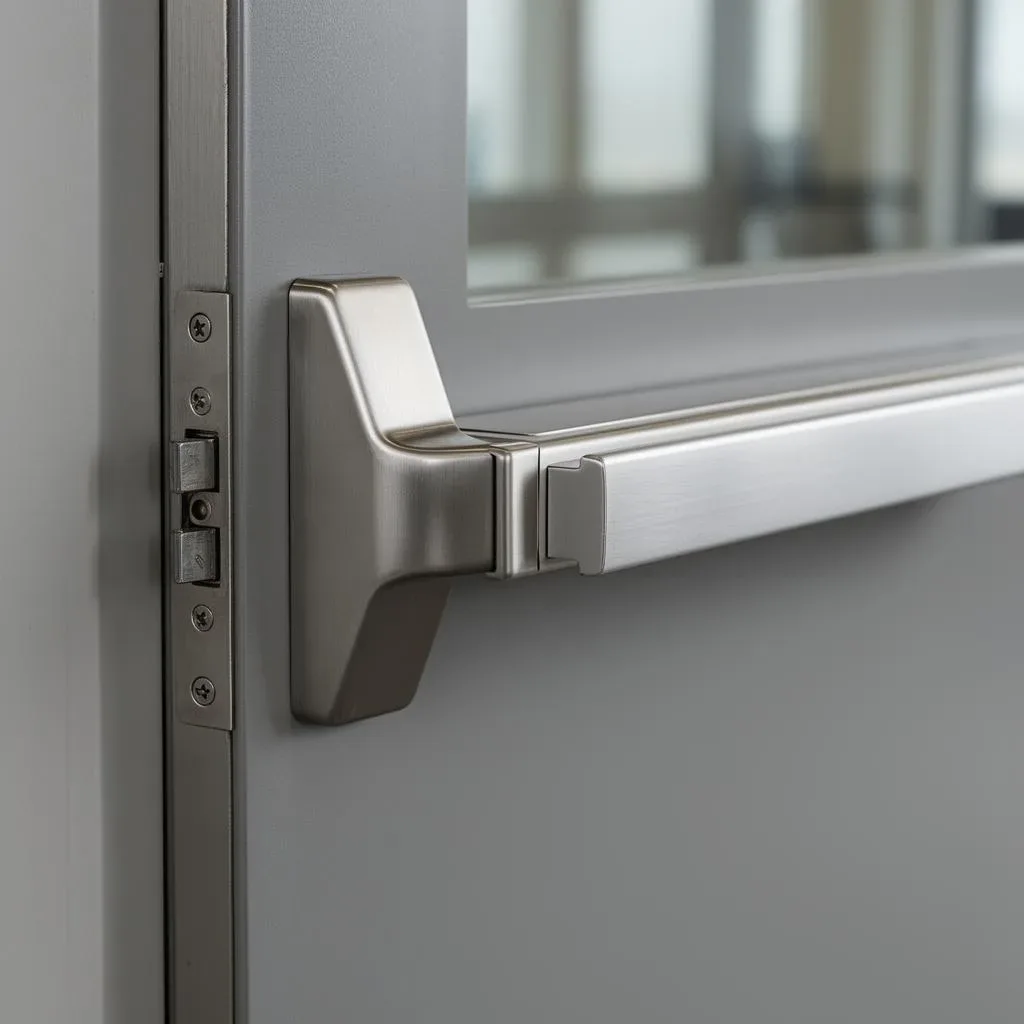
A door with panic hardware can restrict entry from outside while letting people exit from inside. It needs the right outside trim and a latch that engages every time the door closes.
That last part is easy to overlook. A door can look closed from across the room and still pull open from outside. Before buying extra security hardware, find out whether the existing opening is actually latching.
Check what happens after the door closes
Watch the door through a normal opening and closing cycle. Does it settle into the frame, bounce back or stop just short? On a pair, observe both leaves. Record the fault without dismantling the hardware.
| What you notice | What the service visit should investigate |
|---|---|
| Door closes but pulls open | Latch engagement, strike alignment and dogging state |
| One leaf stays unsecured | Rods or cables, strikes, alignment and the mullion |
| Door needs a final pull to latch | Hinges, closer, seals and pressure differences |
| Push bar will not release the door | An exit-device fault needing prompt attention |
| Access system shows a lock command but the door is open | Actual door position and latching |
If a required exit will not operate, follow the site's immediate safety procedure and obtain qualified help. For recurring faults, a short record of when they happen helps the technician. Use the door maintenance checklist.
Turning up a closer to force a misaligned latch into place can create a harder-to-open door while leaving the underlying problem unresolved.
Outside trim controls entry
An exit-only door and a staff entrance serve different purposes. The outside trim determines whether someone enters with a key, operates a controlled lever or has no routine outside access.
The proposed hardware function should match that use. Before eliminating outside access, account for staff needs, emergency access and required reentry. Stairwell doors in particular need review of the applicable reentry arrangement.
Use the manufacturer's exact function description on the quote. Function numbers and terminology do not always carry over between brands.
Dogging belongs in the closing procedure
Dogging holds the latch retracted so a door can operate as push/pull while that function is permitted. Staff can close a dogged door without securing it.
For an opening equipped with this feature, the closing procedure should identify who returns it to the secured state and who checks the latch afterward. Verify the door itself, not just the position of a control.
Mechanical dogging is not permitted on fire exit hardware. Electrified latch retraction on a rated opening requires the appropriate listed arrangement and required behavior. Von Duprin's product documentation distinguishes these options; the fire-door guide covers the wider assembly.
Know what your alarm is reporting
An exit alarm reports an event. A door-position switch reports open or closed. A request-to-exit signal reports activation, while latch monitoring provides information about the latch.
Those signals answer different questions. A system that records a locking command has not necessarily verified that the door is latched. Have the security contractor explain what the installed system actually monitors, what happens during a power loss and who receives an alert.
Also decide who responds. An alert about a propped rear door is useful only if someone can investigate it.
Repair weak points around the device
Loose strikes, damaged frames and failing hinge attachments deserve attention before a hardware upgrade. A well-made device still relies on the material holding it in place.
On paired doors, check the complete latching arrangement. If rim devices depend on a removable mullion, leaving that mullion out prevents them from securing as intended. The rim and vertical rod comparison explains the alternatives.
Glazed doors need a separate assessment of the glass and framing. Security film can form part of that plan, but its performance depends on the full system and it does not guarantee protection against reach-through after breakage.
Keep required exits usable
Do not chain panic bars together, block the opening with stock or add improvised bolts that defeat required exit operation. Fire doors also need their required closing and latching functions intact.
Specialized delayed-egress and controlled-egress arrangements require their own design and approval. Adding a lock and an alarm is not a substitute.
A service assessment should leave you with a clear explanation of the fault, the repair and how the door will operate afterward. The brand comparison helps when replacement hardware is part of that proposal.
Contact Hal's Glass for commercial door service or hollow metal door work. If the damage followed forced entry, start with the break-in response plan.