
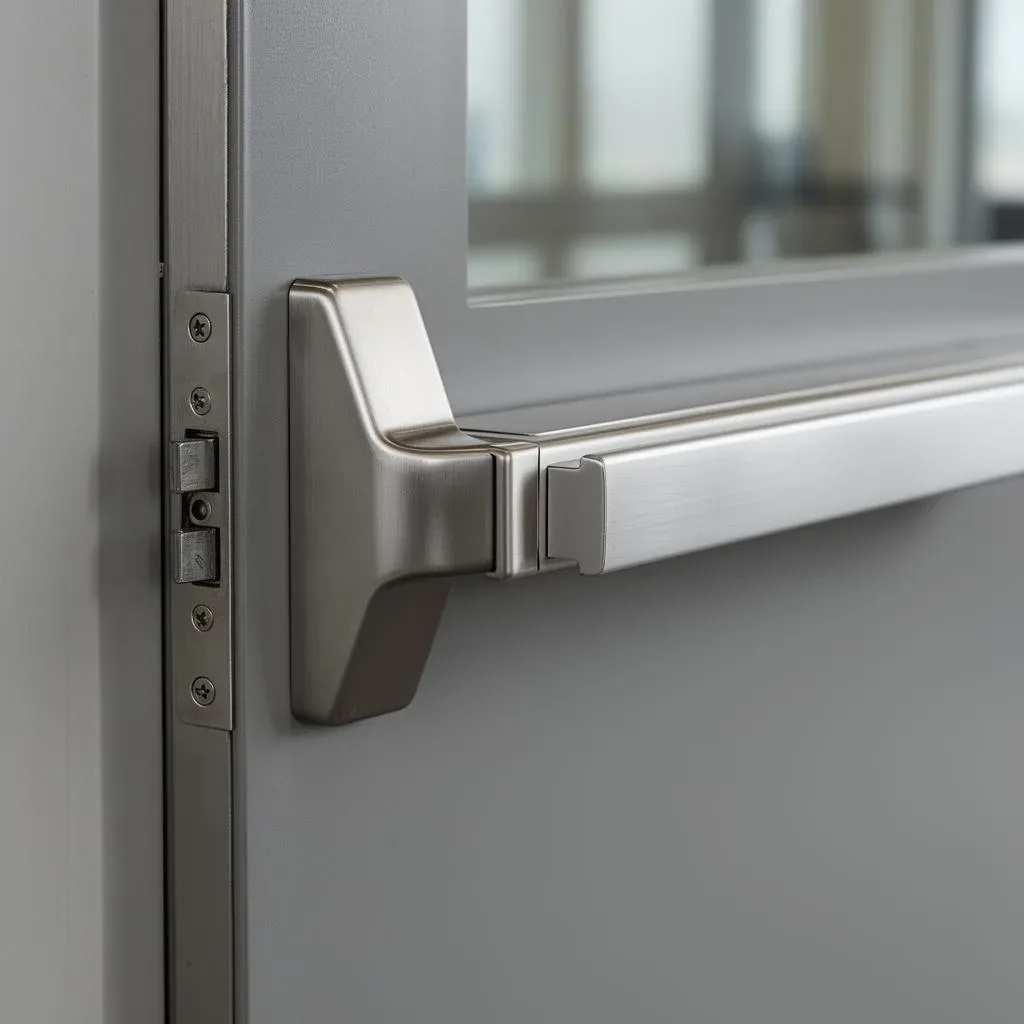
A commercial door looks simple on a quote: one line, one price. But the installed result depends on the frame, the hardware schedule, the fire rating, the closer tuning, and the accessibility requirements — and most of that work happens inside the opening, not on the door itself. Choosing commercial door installers means choosing who handles all of it.
This guide is for planned installation and replacement projects. For vetting a contractor's business overall — licensing, insurance, emergency terms — see our guide to choosing a commercial glass and door contractor.
What commercial door installers actually do
A specialist door installer handles the whole opening, not just the slab:
- Field-measuring the opening and assessing the existing frame and anchors
- Setting or retrofitting frames — steel, aluminum, or wood
- Hanging the door and installing the full hardware schedule: hinges or pivots, closers, locksets, panic devices, thresholds, weatherstripping
- Installing fire-rated assemblies as a labeled system, not a collection of parts
- Tuning closing speed, latching, and opening force so the door passes inspection and daily use
If a bidder's scope stops at "supply and install door," expect the hardware, frame, and tuning to surface as change orders.
Confirm the license covers doors
In California, door installation falls under the CSLB's C-61/D-28 classification (doors, gates, and activating devices); glass door work may also involve the C-17 glazing classification. A general B license doesn't automatically make a contractor the right choice for rated assemblies or storefront entrances. Verify the number on the CSLB site — our contractor guide linked above walks through the lookup.
The questions to ask before signing
These questions separate installers who do this weekly from those who do it occasionally:
- Who field-measures, and when? The installer should measure before ordering — never order off plans or your measurements.
- Is the existing frame being reused, repaired, or replaced — and how was that decided? A reused frame should come with a stated reason it's sound.
- What's in the hardware schedule? Every opening should list hardware by function and grade, not "hardware included."
- Have you installed this door type before? Hollow metal, aluminum storefront, herculite glass, and fire-rated assemblies each have their own failure modes. Ask for a reference on the same type.
- Who handles fire labels and inspection corrections? On rated openings, the answer can't be "we'll figure it out."
- How will the door meet accessibility requirements? Opening force, closing speed, and hardware height are part of installation, not a follow-up. Our California ADA door checklist shows what the finished opening must do.
- What's the lead time, and how is the opening secured in the meantime? Stock hollow metal runs days; custom aluminum or all-glass runs weeks.
- What does the warranty cover — parts, labor, or both — and for how long?
Red flags in a door installation bid
- A per-door price with no hardware schedule or scope description
- No mention of the frame — on a replacement, the frame is often half the job
- "Fire-rated door" quoted without a labeled frame and listed hardware
- No lead time, or a promise that skips fabrication entirely on a custom door
- No plan for securing the opening between removal and installation
- Unwillingness to put exclusions in writing
A bid that includes more isn't necessarily more expensive — it's more honest. Compare full installed scopes, as explained in our door replacement cost and timeline guide.
Why the hardware scope matters more than the slab
Doors themselves rarely fail early. Installations fail at the hardware: closers slamming or leaking, panic devices binding, locks misaligned with strikes, pivots worn by an unbalanced door. The hardware schedule — and the installer's willingness to stand behind its tuning — predicts how the door behaves in year three, not week one.
Ask who services the hardware after installation. An installer who also handles commercial door repair and hardware service has a reason to install it right the first time.
Multi-door and tenant improvement projects
On build-outs and multi-door projects, add scheduling questions: phasing around other trades, keying and master-key coordination, staged deliveries, and who signs off each opening. A door installer experienced in tenant improvement work will have answers ready; a residential installer moonlighting on commercial won't.
Do commercial door installers supply the doors?
Usually yes — specialists order doors and hardware to the field measure. Owner-supplied doors often cause fit and warranty disputes, so clarify responsibility before ordering anything yourself.
How long does a commercial door installation take?
Installation itself is typically half a day to one full day per opening once materials arrive. The lead time is in fabrication: days for stock hollow metal, two to four weeks for custom aluminum or all-glass doors.
Should one company handle the door, glass, and hardware?
When the opening includes glass — storefront doors, sidelites, transoms — a single glazier-door specialist avoids the gap where the door contractor blames the glass contractor and vice versa.
Hal's Glass installs and services commercial doors, hollow metal doors and frames, and ADA-compliant door hardware across Los Angeles, Orange, Riverside, and San Bernardino Counties. Send us your project details for a written scope and quote, or call (562) 866-7047 to talk through the opening with our team.