
Once a commercial door is past economical repair, the questions change fast: what will a new door cost, how long will the opening be out of service, and what exactly are you paying for? This guide answers all three with real ranges from work we do across Los Angeles, Orange, Riverside, and San Bernardino Counties.
If you haven't decided between repair and replacement yet, start with our repair vs. replacement decision guide. This article picks up where that one ends.
What commercial door replacement costs
Installed pricing depends on door type, size, hardware, and whether the frame is reused. These are typical installed ranges for Southern California commercial work:
| Door type | Typical installed range | Notes |
|---|---|---|
| Hollow metal door (leaf only, existing frame) | $900–$1,800 | Sound frame, standard hardware prep |
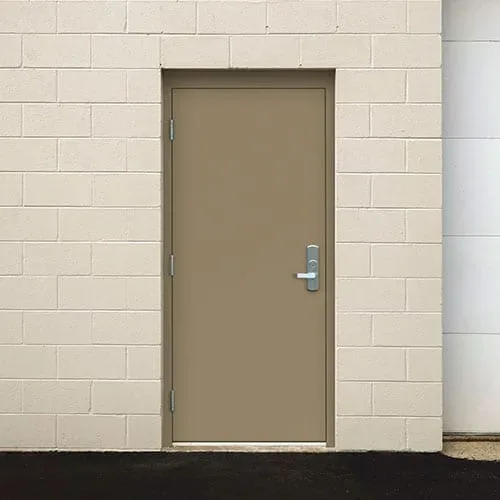
| Hollow metal door and frame assembly | $1,800–$4,000 | New frame set in existing opening |
| Aluminum storefront glass door | $1,500–$3,500 | Includes pivots, closer, standard lock |
| Herculite (all-glass) door | $2,500–$5,000 | Custom tempered glass, patch fittings |
| Fire-rated door assembly | $2,000–$4,500 | Labeled door, frame, and listed hardware |
Ranges assume standard sizes and grades. Oversized openings, custom finishes, electrified hardware, and after-hours installation push costs higher. Any quote you receive should state exactly which of these it includes — a low number that excludes hardware or the frame isn't comparable to one that doesn't.
What drives the price
- Frame condition. Reusing a sound frame saves money. A rusted or racked frame has to go — and frame work is often half the job. Our guide to failing hollow metal frames covers the warning signs.
- Hardware. Panic devices, closers, electric strikes, and card-reader prep can equal the cost of the door itself. Reusing existing hardware is sometimes possible but rarely worth it on a door that's being replaced for wear.
- Fire rating. A rated opening needs a labeled door, frame, and listed hardware installed as an assembly. You can't mix unrated parts into a rated opening.
- Glass. Door lites, sidelites, and transoms are priced by glass type — tempered, laminated, or insulated — and size.
- Access and timing. After-hours work, occupied retail spaces, and difficult staging all add labor.
How long replacement takes
Most commercial door replacements follow the same four stages:
| Stage | Typical time |
|---|---|
| Site measure and written quote | 1–3 business days from your call |
| Ordering / fabrication | Stock hollow metal: 3–7 days. Custom aluminum or herculite: 2–4 weeks |
| Installation | Half a day to one full day per opening |
| Hardware tuning and inspection | Same visit as installation |
The wait is almost always fabrication, not labor. If your opening can't wait weeks for a custom door, a stock-sized replacement or temporary securing can bridge the gap — after a break-in, our 24/7 emergency board-up crew secures the opening the same night while the permanent door is fabricated.
When repair stops making sense
Repairs are the right call for most door problems — closers, pivots, latches, and alignment are all economical fixes, and most commercial door repairs run $250–$900. Replacement wins when the structure of the door or frame is the problem:
- Rust through the door or frame, especially at the bottom rail or frame base — patching corrosion is a short-term cosmetic fix.
- Damage at hardware reinforcements — when the metal holding the closer, pivot, or lock tears out, there's nothing left to fasten to.
- A twisted or racked door that no longer seals, latches, or closes square in the frame.
- Repeated service calls for the same opening — three repairs in a year usually costs more than the replacement nobody wanted to approve.
- A change in code or use — new occupancy, a required fire rating, or accessibility upgrades the existing door can't accept. Our California ADA door checklist covers the accessibility side.
The useful comparison is full installed scope against full installed scope — not the repair invoice against the sticker price of a door slab.
What a replacement quote should include
Before you approve any commercial door replacement, the written quote should spell out:
- Door and frame: material, gauge, size, finish, and any fire label
- Whether the existing frame is being reused, repaired, or replaced
- All hardware by function: hinges or pivots, closer, lockset or panic device, threshold, weatherstripping
- Glass: type, thickness, and any sidelites or transoms
- Disposal of the old door, patching, and finish work at the opening
- Lead time and how the opening will be secured if fabrication takes weeks
A quote missing any of these lines isn't a better price — it's an incomplete scope.
Can a new door be installed in the old frame?
Yes, if the frame is plumb, solidly anchored, and free of corrosion. It saves meaningful money. If the frame is the reason the door failed, reusing it just transfers the problem to the new door.
Do I need a permit to replace a commercial door?
Like-for-like replacement typically doesn't require a permit in most Southern California cities. Changing the opening size, adding a fire-rated assembly, or altering an accessible route can trigger plan review — your contractor should flag this in the quote.
Can you replace the door without closing my business?
In most cases, yes. We schedule installations before opening, after close, or in off-peak windows, and a single door is usually swapped in under a day.
Hal's Glass replaces commercial doors of every type — hollow metal doors and frames, aluminum storefront doors, and herculite all-glass doors — across Los Angeles, Orange, Riverside, and San Bernardino Counties. Send us photos and rough dimensions of your opening and we'll return a written, line-item quote — or call (562) 866-7047 to schedule a measure.