
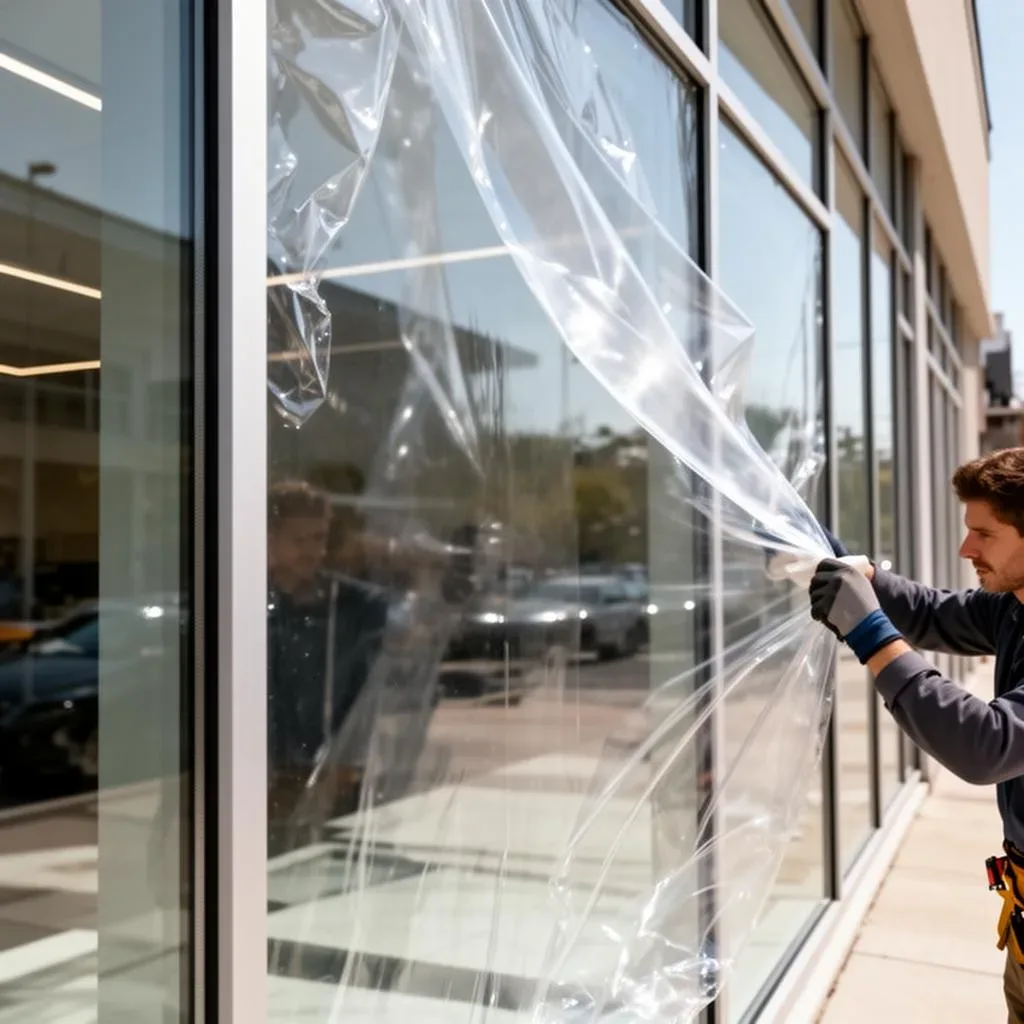
Security window film is applied to glass to help hold fragments together after breakage. In a suitable tested system, it can also delay forced entry. The glass still breaks. The question is what happens to the broken pane afterward.
For a storefront owner, that is the useful starting point. A film demonstration shows only part of the story unless you know how the glass, frame and attachment compare with your own opening.
The film holds glass fragments together
The adhesive bonds the film to the glass. When the pane breaks, the film helps keep the fragments together instead of allowing them to separate freely.
Holding those fragments together and holding the broken sheet in the frame are separate jobs. Tempered glass breaks into small pieces, so the way the filmed pane connects to its surrounding frame deserves particular attention. Film applied only to the visible glass does not by itself establish that the broken pane will remain in the opening.
The IWFA Safety and Security Education Guide explains why attachment and the complete glazing assembly matter when evaluating performance.
Attachment connects the film to the frame
An attached security-film system uses a specified mechanical or sealant detail to connect the film to the frame. The materials and installation detail are part of the system. A generic bead of caulk does not establish the same performance.
You might also see “daylight application,” meaning film applied to the exposed glass and ending near the frame, or “edge-to-edge,” where film extends across the pane into concealed edge areas. Have the proposal show which arrangement is included and how it supports the intended result.
This is also the time to inspect the frame. Loose or damaged framing needs attention before choosing a retrofit that relies on it. Hal's Glass's security-film service page lists anchored systems; the assessment should identify the product and attachment detail suited to the actual property. Storefront repair may need to come first.
Read the result behind a test claim
Start by describing what you want to address: broken-glass fragments, smash-and-grab entry or another specific concern. Then request evidence that addresses that concern.
A useful report identifies the test standard and edition, the glass and film tested, the frame, attachment, specimen size and result. “Tested to” a standard leaves an important question unanswered: what result did the assembly achieve?
Keep the test purpose in view. Safety-impact testing does not establish burglary resistance. A forced-entry result does not establish bullet resistance, and a blast result does not establish earthquake performance. For school security, ballistic protection or overhead glazing, obtain a qualified assessment of the required system.
Film thickness is another common selling point. It is usually expressed in mils, or thousandths of an inch. That number identifies one product characteristic. It does not replace evidence about the installed assembly.
Put entry delay in context
A suitable security-film assembly can make entry more difficult, but there is no universal number of seconds or minutes to promise for every storefront. Glass, framing, installation and the attack all affect the outcome.
Film does not make a pane unbreakable or bulletproof. Nor does it repair cracked glass, fix a failed lock or guarantee that insurance will cover a loss. Treat it as one part of the property plan, alongside working doors, monitoring and a response procedure. Our panic-bar security guide covers the door side.
If the storefront has already been broken into, secure the opening first. The break-in response plan helps organize that work before the permanent-repair discussion.
What belongs in the installation quote
The quote should name the film and list the panes receiving it, the existing glass, the application side and the attachment method. It should also connect the claimed performance to supporting evidence.
Include preparation and aftercare in the conversation. Existing coatings or film affect compatibility. The installer should explain curing conditions, when the system reaches its intended condition, cleaning instructions and warranty exclusions. Keep that information with the installation record rather than relying on a product brochure alone.
Choose a different product for a different problem
Laminated glass contains an interlayer as part of the manufactured glazing. Applied film is a retrofit treatment. Compare each as part of a complete opening with the performance you need.
For scratches and etched graffiti, anti-graffiti film serves a different purpose: a replaceable surface layer. The film comparison guide explains where each category fits.
To request an assessment, send photos of the panes and frames and describe the problem you want to solve. That gives the installer a better starting point than a request for a particular film thickness.