
In a warehouse or distribution building, a door that won't open — or won't close — isn't a maintenance ticket, it's an operations stoppage. Across the Inland Empire's logistics corridors, we see the same pattern: a high-speed or roll-up door takes an impact or wears out a component, and the building loses security, climate control, or a dock position until it's fixed. This guide covers what fails, what downtime really costs, and how to stay ahead of it.
What makes high-speed doors different
A standard commercial door cycles a few dozen times a day. A high-speed door at a busy dock can cycle hundreds of times — which is exactly why they exist, and exactly why they wear differently:
- Cycle-rated motors and drives designed for rapid open/close, with components sized by expected cycles
- Flexible curtains or sectional panels that move fast and absorb occasional contact
- Safety systems — photo eyes, light curtains, reversing edges — that stop the door instantly and shut the opening down when they fault
- Counterbalance and spring systems under constant load
Everything on a high-speed door is engineered around speed and cycle count, so generic door repair approaches — and generic door parts — often don't transfer.
The failures we see most
| Failure | Usual cause | Typical fix |
|---|---|---|
| Door won't close or reverses | Photo eye or safety edge fault | Sensor alignment or replacement |
| Curtain or panel damage | Forklift or pallet impact | Section or curtain replacement |
| Door opens slowly or strains | Motor, drive, or counterbalance wear | Component replacement and retuning |
| Door off track | Impact or guide wear | Track repair, guide replacement, reset |
| Grinding or shuddering | Worn rollers, bearings, or drive parts | Caught early: parts. Ignored: motor. |
Impact damage is the most common call at docks — a forklift clips a curtain or a panel section, and the opening is compromised. Many high-speed doors are designed to break away and reset after minor contact; when they don't reset cleanly, forcing them makes the repair bigger.
What downtime actually costs
The repair invoice is rarely the expensive part:
- Security — an opening that won't close is an unsecured building overnight
- Climate control — conditioned air pours out of a stuck-open door; in food and cold storage, product is at risk
- Pest and dust intrusion — a real compliance issue for food-grade facilities
- Lost dock positions — trucks reroute, loads reschedule, and the bottleneck compounds through the shift
If an opening can't be made operational the same visit, it still has to be secured. Our 24/7 emergency board-up team covers that across Los Angeles, Orange, Riverside, and San Bernardino Counties while parts are sourced.
Repair or replace?
High-speed doors are built to be repaired — curtains, panels, motors, and sensors are all replaceable components. Replacement makes sense when the door has chronic impact damage at the same location (a layout problem the door keeps paying for), when parts are obsolete, or when cycle counts have worn the system past economical repair. A door that's down monthly is costing more than a new one.
The maintenance schedule that prevents downtime
| Interval | What to check |
|---|---|
| Daily (operator staff) | Full open/close cycle, safety sensor response, unusual noise |
| Monthly (maintenance) | Photo eye alignment, curtain/panel condition, track and guide wear |
| Quarterly or semiannual (professional) | Motor and drive service, counterbalance tension, safety system testing, cycle counter review |
On high-cycle doors, the cycle counter — not the calendar — should drive professional service. A door rated for a million cycles that runs 800 cycles a day reaches its service interval fast.
Can a high-speed door be repaired after a forklift impact?
Usually, yes. Breakaway designs and replaceable curtain sections exist for exactly this reason. The key is not cycling a damaged door — each forced cycle can turn a section replacement into a track and drive repair.
Do you service standard roll-up and sectional dock doors too?
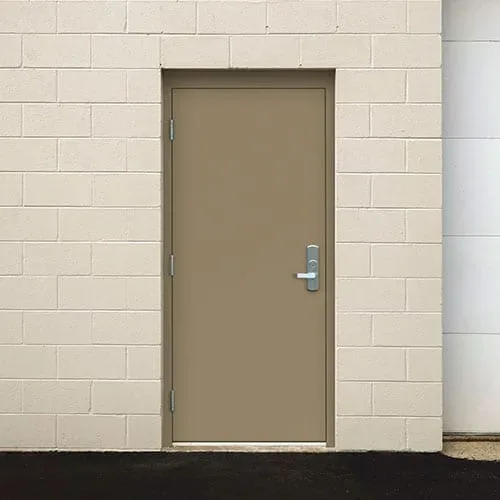
Yes. We repair roll-up doors, sectional doors, hollow metal personnel doors, and the dock-level hardware around them throughout the Inland Empire and greater Southern California.
How fast can you respond to a stuck dock door?
For genuine emergencies — a building that can't be secured — we dispatch 24/7. Planned repairs and maintenance are scheduled around your operations to avoid dock conflicts.
Hal's Glass repairs high-speed, roll-up, and hollow metal doors for warehouses and distribution facilities across Southern California — including Ontario, Fontana, and Rancho Cucamonga. For multi-facility coverage, see our multi-site vendor program. Call (562) 866-7047 or request a door assessment for your facility.